Thursday, January 5, 2023

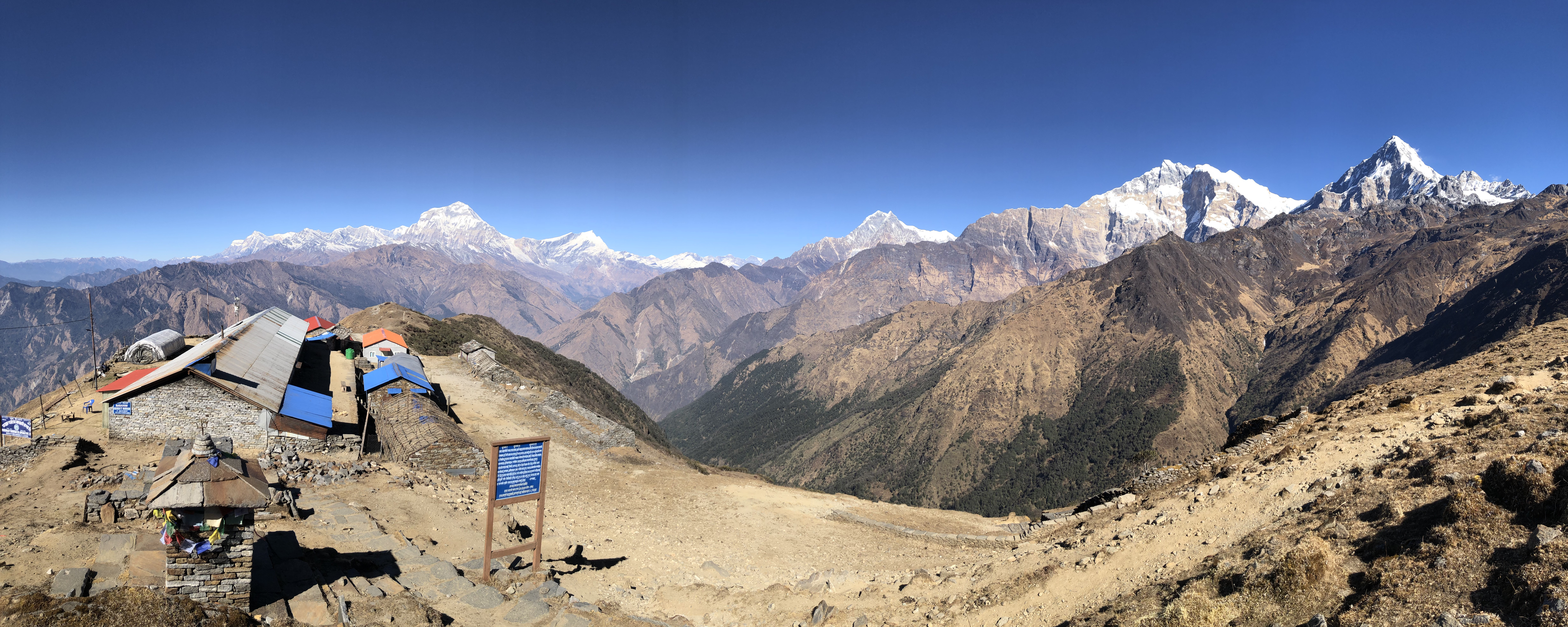
Wider scapes of Mt Dhaulagiri and Mt Annapurna Region

It was a journey I was longing for. That I had not been to the Himalayas for long had created a big void in me. Being there, feeling the mountains, the thin air, witnessing the abundance, the vastness, mesmerizing valleys, inviting peaks, frozen streams, weathered ridges, those singing birds, the silent forests, beautiful wild blooms despite the frost, blue winter skies and the cold landscapes of the Mt Annapurna himalayan range, has brought me back to life. Here are some wider panoramas of the unreal landscapes I walked over for a few days.

(click on the images for a better view)

Farming lands of the village from where I started the journey

View of the valley on the way to village on the southern side of Annapurna

Sunrise at a village south of Annapurnas

Beautiful grassy slopes on the way to the ridge

Community lodge at 3315m with the backdrop of Mt Dhaulagiri and Mt Annapurna family

Viewing the Mt Annapurna range on the way towards Annapurna Sanctuary

Crossing the bridge across the beautiful stream on the way to a village at the base of Annapurna range

School (on the right) and the temple (on the left) with the backdrop of Mt Dhaulagiri at the village

Terrace farming at the beautiful little village on the way to the higher ridge

 A natural bridge across the stream just before climbing to the next village


View of the ridge as we climb up from the village

As I climbed up the ridge, the views of Mt Dhaulagiri and the valleys were mesmerizing

Community lodge (3660 m) with the backdrop of Mt Dhaulagiri and Mt Annapurna range

The valley view from the ridge

The panoramic view of the entire Annapurna range from the ridge


All ready to get painted with the hues of sunset

Surreal landscape during the magical sunset

Frozen valleys during my climb to the high altitude Baraha Tal / Khayer lake

Baraha Tal / Khayer Lake (4700 m) right at the base of Mt Annapurna south

Khayer temple, the frozen lake and the glacier at the base of Mt Annapurna South

Climb to the Khayer lake was pretty intense and draining. The views around the glacier were surreal.

At the midpoint to the lake, the views opens into a large valley with the tricky frozen river to cross. 

Got back from the lake just in time to witness this magical hues during the sunset on the ridge

As I started descending from the ridge, green valleys started to appear

Magical valley seen from the village

Thank you!
Srikanth Parthasarathy

Sunday, June 13, 2021

we're big too

 Excerpt from the book 'Fundamentals - Ten Keys to Reality by Frank Wilczek' 


The world is large, but we are not small. It is truer to say that there's plenty of space, whether we scale up or down. One shouldn't envy the universe just because it's big. We're big, too. We're big enough, specifically, to contain the outer universe within our minds.

~~

All these days, I have heard many saying we are 'too small' compared to .... And yes, may be philosophically. But fundamentally, we're big enough as we have the universe within us.


Srik

Tuesday, October 1, 2019

BU 4.4.8 - Immortal lifebreath

Excerpt from the book 'Upanishads' - A new translation by Patrick Olivelle

Brhadaranyaka Upanishad

There is an ancient path
  extremely fine and extending far;
It has touched me, I've discovered it!
By it they go up to the heavenly world
released from here,
wise men, knowers of brahman.

In it are the white and the blue, they say,
  the orange, green, and red.
By brahman was this path discovered;
By it goes the knower of brahman,
  the doer of good, the man of light.

Into blind darkness they enter, 
  people who worship ignorance;
And into still blinder darkness,
  people who delight in learning.

'Joyless' are those regions called,
in blind darkness they are cloaked;
Into them after death they go,
  men who are not learned or wise. 

If a person truly perceives the self,
  knowing 'I am he';
What possibly could he want,
Whom possibly could he love,
  that he should worry about his body?

The self has entered this body, this dense jumble.
  If a man finds him,
  Recognizes him,
He's the maker of everything - the author of all!
The world is his - he's the world itself!

While we are still here, we have come to know it.
If you've not known it, great is your destruction.
Those who have known it - they become immortal.
As of the rest - only suffering awaits them.

When a man clearly sees this self as god,
  the lord of what was
  and of what will be,
He will not seek to hide from him.

Beneath which the year revolves
  together with its days,
That the gods venerate
  as the light of lights,
  as life immortal.

In which are established 
  the various groups of five,
  together with space;
I take that to be the self - 
  I who have the knowledge,
  I who am immortal,
I take that to be - 
  the brahman,
  the immortal.

The breathing behind breathing, the sight behind sight,
  the hearing behind hearing, the thinking behind thinking - 
Those who know this perceive brahman,
  the first,
  the ancient.

With the mind alone must one behold it - 
  there is here nothing diverse at all!
From death to death he goes, who sees
  here any kind of diversity.

As just singular must one behold it - 
  immeasurable and immovable,
The self is spotless and beyond space,
  unborn, immense, immovable.

By knowing that very one a wise Brahmin
  should obtain insight for himself.
Let him not ponder over a lot of words;
  it just tires the voice!

~~

BU 4.4.7 - A man of desire

Excerpt from the book 'Upanishads' - A new translation by Patrick Olivelle

Brhadaranyaka Upanishad 

A man resolves in accordance with his desire, acts in accordance with his resolve, and turns out to be in accordance with his action. 

      A man who's attached goes with his action,
        to that very place to which
        his mind and character cling.
      Reaching the end of his action,
        of whatever he has done in this world - 
      From that world he returns
        back to this world,
        back to action.

'That is the course of a man who desires.
'Now, a man who does not desire - who is without desires, who is freed from desires, whose desires are fulfilled, whose only desire is the self - his vital functions (prana) do not depart. Brahman he is, and to brahman he goes. 

      When they all are banished,
        those desires lurking in one's heart;
      Then a mortal becomes immortal,
        and attains brahman in this world. 

~~

A man turns into something good by good action and into something bad by bad action. 

Srik

Monday, September 30, 2019

good sense

Excerpt from the book 'Discourse on Method and Meditations on First Philosophy' by Rene Descartes

Good sense is the best distributed thing in the world, for everyone thinks himself to be so well endowed with it that even those who are the most difficult to please in everything else are not at all wont to desire more of it than they have. It is not likely that everyone is mistaken in this. Rather, it provides evidence that the power of judging well and of distinguishing the true from the false (which is, properly speaking, what people call "good sense" or "reason") is naturally equal in all men, and that the diversity of our opinions does not arise from the fact that we lead our thoughts along different paths and do not take the same things into consideration. For it is not enough to have a good mind; the main thing is to apply it well. The greatest souls are capable of the greatest vices as well as of the greatest virtues. And those who proceed only very slowly can make much greater progress, provided they always follow the right path, than do those who hurry and stray from it. 

~~
Well... yeah! Couldn't agree more!

Srik

Thursday, September 26, 2019

BU 3.9.28 - mighty tree

Excerpt from the book 'Upanishads' - A new translation by Patrick Olivelle

- Brhadaranyaka Upanishad - 

Man is like a mighty tree-
    that's the truth.
His body hairs are its leaves, 
His skin is its outer bark.
Blood flows from his skin,
As sap from the bark of a tree.
Blood flows when the skin is pricked,
As sap, when the bark is slit.

His flesh is the sapwood;
His sinews are the fibres -
    that's certain.
His bones are the heartwood;
And his marrow resembles the pith.

A tree when it's cut down,
Grows anew from its root;
From what root does a mortal man grow,
When he is cut down by death?

Do not say, 'From the seed';
For it's produced from him
    while he is still alive;
And like a tree
    sprouting from a seed,
It takes birth at once,
    even before he dies.

A tree, when it's uprooted,
will not sprout out again;
From what root does a mortal man grow,
When he is cut down by death?

Once he's born,
    he can't be born again.
Who, I ask,
    will beget him again?

Perception, bliss, brahman,
The gift of those who give,
The highest good - 
    awaits those who know this
    and stand firm.

~~
Very thoughtful and thought provoking. A great comparison to a tree.


BU 2.4.1 - Immortality

Excerpt from the book 'Upanishads' - A new translation by Patrick Olivelle

- Brhadaranyaka Upanishad -

'Maitreyi!' Yajnavalkya once said. 'Look - I am about to depart from this place. So come, let me make a settlement between you and Katyayani.

Maitreyi asked in reply: 'If I were to possess the entire world filled with wealth, sir, would it make me immortal?' 'No', said Yajnavalkya. 'it will only permit you to live the life of a wealthy person. Through wealth one cannot expect immortality.'

'What is the point in getting something that will not make me immortal?' reported Maitreyi. 'Tell me instead, sir, all that you know.'

Yajnavalkya said in reply: 'You have always been very dear to me, and now you speak something very dear to me! Come and sit down. I will explain it to you. But while I am explaining, try to concentrate.' Then he spoke:

'One holds a husband dear, you see, not out of love for the husband; rather. it is out of love for oneself (atman) that one holds a husband dear. One holds a wife dear not out of love for the wife; rather, it is out of love for oneself that one holds a wife dear. One holds children dear not out of love for the children; rather, it is out of love for oneself that one holds children dear. One holds wealth dear not out of love for wealth; rather, it is out of love for oneself that one holds wealth dear. One holds the priestly power dear not out of love for the priestly power; rather, it is out of love for oneself that one holds the priestly power dear. One holds the royal power dear not out of love for the royal power; rather, it is out of love for oneself that one holds the priestly royal dear. One holds the worlds dear not out of love for the worlds; rather, it is out of love for oneself that one holds the worlds dear. One holds the gods dear not out of love for the gods; rather, it is out of love for oneself that one holds the gods dear. One holds the beings dear not out of love for the beings; rather, it is out of love for oneself that one holds the beings dear. One holds the Whole dear not out of love for the Whole; rather, it is out of love for oneself that one holds the Whole dear.'

'You see, Maitreyi - it is one's self (atman) which one should see and hear, and on which one should reflect and concentrate. For by seeing and hearing one's self, and by reflecting and concentrating on one's self, one gains the knowledge of this whole world.'

May the priestly power forsake anyone who considers the priestly power to reside in something other than his self (atman). May the royal power forsake anyone who considers the royal power to reside in something other than his self. May the gods forsake anyone who considers the gods to reside in something other than his self. May beings forsake anyone who considers beings to reside in something other than his self. May the Whole forsake anyone who considers the Whole to reside in something other than his self.

All these - the priestly power, the royal power, worlds, gods, beings, the Whole - all that is nothing but this self.  

~~

I'm on a high! sigh!

Wednesday, September 25, 2019

BU 1.5.1

Excerpt from the book 'Upanishads' - A new translation by Patrick Olivelle

- Brhadaranyaka Upanishad -

    By wisdom and by toil,
    when the father produced
    the seven kinds of food - 

One was common to all here.
Two he assigned to the gods.
Three he kept for himself.
One he gave to the beasts.

    All beings depend on it,
    both those that breathe
    and those that do not.

Why aren't they exhausted,
when they are eaten every day?

The man who knows it
as the inexhaustible - 

    he eats food with his face;
    he reaches the gods;
    he lives on invigorating food.

--

BU 1.4.16

Excerpt from the book 'Upanishads' - A new translation by Patrick Olivelle

-Brhadaranyaka Upanishad-

Now, this self (atman) is a world for all beings. So, when he makes offerings and sacrifices, he becomes thereby a world for the gods. When he recites the Vedas, he becomes thereby a world for the seers. When he offers libations to his ancestors and seeks to father offspring, he becomes thereby a world for his ancestors. When he provides food and shelter to human beings, he becomes thereby a world for human beings. When he procures fodder and water for livestock, he becomes thereby a world for livestock. When creatures, from wild animals and birds down to the very ants, find shelter in his houses, he becomes thereby a world for them. Just as a man desires the well-being of his own world, so all beings desire the well-being of anyone who knows this. All this is known and has been thoroughly examined. 

--
Well, it all started here I suppose!


Friday, April 5, 2019

blind

beliefs that are in the air
arguments that are not grounded
to not question and how
to not reason and out of mind
signing up for the falling
flowing into the herd
following other voices
or just one such
sleeping through the time
drugged to be happy
masked by the false
fooled by the mass
ignoring self
....
....
....


--
Srik


dare to understand

Excerpt from the book Enlightenment Now by Steven Pinker

In his book The Beginning of Infinity, David Deutsch argues that if we dare to understand, progress is possible in all fields, scientific, political, and moral:

Optimism (in the sense that I have advocated) is the theory that all failures - all evils - are due to insufficient knowledge... Problems are inevitable, because our knowledge will always be infinitely far from complete. Some problems are hard, but it is a mistake to confuse hard problems with problems unlikely to be solved. Problems are soluble, and each particular evil is a problem that can be solved. An optimistic civilisation is open and not afraid to innovate, and is based on traditions of criticism. Its institutions keep improving, and the most important knowledge that they embody is knowledge of how to detect and eliminate errors. 

--

Enlightenment's motto is "Dare to understand!" and its foundational demand is freedom of thought and speech. 

Srik

why should I live?

Excerpt from the book Enlightenment Now by Steven Pinker

"Why should I live?" 

In the very act of asking that question, you are seeking reasons for your convictions, and so you are committed to reason as the means to discover and justify what is important to you. And there are so many reasons to live.

As a sentient being, you have the potential to flourish. You can refine your faculty of reason itself by learning and debating. You can seek explanations of the natural world through science, and insight into the human condition through the arts and humanities. You can make the most of your capacity for pleasure and satisfaction, which allowed your ancestors to thrive and thereby allowed you to exist. you can appreciate the beauty and richness of the natural and cultural world. As the heir to billions of years of life perpetuating itself, you can perpetuate life in turn. You have been endowed with a sense of sympathy - the ability to like, love, respect, help, and show kindness - and you can enjoy the gift of mutual benevolence with friends, family, and colleagues. 

And because reason tells you that none of this is particular to you, you have the responsibility to provide to others what you expect for yourself. You can foster the welfare of other sentient beings by enhancing life, health, knowledge, freedom, abundance, safety,  beauty, and peace. History shows that when we sympathise with others and apply our ingenuity to improving the human condition, we can make progress in doing so, and you can help to continue that progress. 

--

Reason! 

Srik


Wednesday, April 3, 2019

second-order questions

Excerpt from the book The Four Horsemen

Maybe faith and belief in divinity and an afterlife, even if founded on claims for which there can be no evidence, may nonetheless be considered a force for good?

Maybe they offer moral guides and ethical codes without which the world would be a cruel and riotous place? Much of what we live by is metaphor. Why shouldn't we accept a religious narrative irrespective of its truth - as a framework in this relativist culture cursed by the disappearance of structure, hierarchy, and meaning?

And what about spiritual, the numinous immanence we all feel? Can you really deny that there is a realm which reason and numbers and microscopes cannot penetrate?

--

Open inquiry, free thinking and the unfettered exchange of ideas yield real and tangible fruit. 

Srik

Thursday, December 27, 2018

Penukonda Fort

Penukonda is in the Anantapur District of Andhra Pradesh. As per the 2011 census the population of the town is 27,382. It is about 70 km south of Anatapur and about 143 km north of Bengaluru on National Highway 44 or the Bengaluru-Hyderabad Highway. In 2017 KIA Motorsof South Korea announced the location of an automobile manufacturing plant near Penukonda with an estimated investment of 2 billion dollars. A functioning Korean Restaurant on the main street in the town attests to the validity of the announcement.

Based upon inscriptions archaeologists have determined that the well-known Penukonda Fort was built during the 14th century by Vira Virupanna Udaiyar, the son of one of the founders of Vijaynagar Empire Bukka I. The fort is in ruins and it is difficult to see the full configuration of the original structure. The remnants, however, give a fairly good picture of what it might have been at its zenith. It is easy enough to imagine that it was a formidable fort that was built for effective defence with moats and bastions. At one time there were seven bastions along the perimeter of the fort. At the Yerramanchi Gate, the main entrance, there is a large granite sculpture of god Hanuman that is 11 feet tall. The narrow streets and some dwellings inside the fort bear witness to their origins from the 14th century.


On the way to the fort hill, overlooking Penukonda town

Fort walls on the way to the top of fort hill

Jeep road to the fort hill

Entrance to the fort hill complex

Mantapa at the Royal Centre on top of the fort hill

Dilapidated abandoned Lakshmi Narasimha Temple on top of the fort hill

Mantapa opposite to the temple

View of the Royal Centre ruins

Broken gopura of Lakshmi Narasimha Temple 

Ruins of Lakshmi Narasimha Temple

Garbha Gudi of Lakshmi Narasimha Temple

Gopuras 

A large kalyani with a mantapa at the Royal Centre 

Hanumantha carving at the fort entrance

Pedestrian entry to the fort

Yerramanchi Gate: Main fort gate in Penukonda town

A temple at the entrance of Penukonda Fort complex

The Mosque is an imposing building. The entrance is clearly through what was at one time a Hindu temple entrance with a gopura. The gopura has been demolished or has been let to suffer the vagaries of nature. The entrance way has maintained the Hindu temple columns indicating a preference for appropriating established architecture to ensure legitimacy of the succeeding ruler. Given this fact, it is reasonable to assume that the original Hindu temple was razed to make way for the Mosque. 

A hindu temple converted mosque in Penukonda

The following description is provided by the Archaeology and Museums Department:

An old Hindu palace i.e. Gagan Mahal is located to the south of Ramaswamy and Eshwara temples. It was the summer palace and harem of Vijayanagara rulers. The building is facing east and composes of two stories of arcade chambers, square on plan with corner tower on the northern side. In front of the building there are steps leading into the building also staircases on either sides leads to the first floor. The ground floor consisting with recessed and forty five foliated arches in the pavilion reminiscent of the Lodi type of arches in the buildings of Delhi. The middle of the ground floor and first floor made a provision of rooms. The first floor has twelve arches and eight windows. The surface of the walls of building is coated with stucco. The pyramidal roof built-up in tiers is obviously adopted from Sikhara of the Dravidan style. The tower has six projecting windows supported by brackets. It was built by a combination of Indo-Persian architectural style known as Indo-Sarcanic adopted by Vijayanagara kings. The palace was built without a single rafter, a unique specimen architecture.

Gagan Mahal Palace built in 1585

Painting of Sr Krishna Devaraya inside the palace

Peek into village outside the palace 
The Timmarasu Prison is a monument to a great tragedy. Even great leaders like Krishna Deva Raya were driven by unfounded rumours (fake news), innuendos, and character assassinations. Belated remorse, regrettably, does not remedy the error. The small stylized building leaves no doubt that a prisoner could not escape the confines of this small space in the mold of isolation chambers in contemporary prisons. The three largest mass murderers of the twentieth century, Mao Tse Tung, Stalin, and Hitler would approve of the accommodation.

Thimmarasu Jail 
The Basavana Bavi (Well) is an impressive deep stepped tank on a smaller scale than the one at the Royal Centre in Vijaynagar. The two entrances to the steps leading to the well are under two large bulls. Looked at from the rear it is bound to bring smiles to the face of the onlooker. There is a contemporary school building that is under construction abutting the historic well and the historic mantapa. It is a shame that this has been permitted in an area suffused with heritage. Tastelessness, evidently, is not unique to the current President of the United States.

Basavana Baavi (well)

Basavana Baavi (well)


(Click on the photographs for an enlarged view)

Text: Narasim Katary
Photographs: Srik Parthasarathy

Thursday, November 8, 2018

If only Chukwu had a twitter account

Excerpt from the book Homo Deus by Yuval Noah Harari

Throughout history most gods were believed to enjoy not omnipotence but rather specific super-abilities such as the ability to design and create living beings; to transform their own bodies; to control the environment and the weather; to read minds and to communicate at a distance; to travel at very high speeds; and of course to escape death and live indefinitely. Humans are in the business of acquiring all these abilities, and then some. Certain traditional abilities that were considered divine for many millennia have today become so commonplace that we hardly think about them. The average person now moves and communicates across distances much more easily than the Greek, Hindu or African gods of old. 

For example, the Igbo people of Nigeria believe that the creator god Chukwu initially wanted to make people immortal. He sent a dog to tell humans that when someone dies, they should sprinkle ashes on the corpse, and the body will come back to the life. Unfortunately, the dog was tired and he dallied on the way. The impatient Chukwu then sent a sheep, telling her to make haste with this important message. Alas, when the breathless sheep reached her destination, she garbled the instructions, and told the humans to bury their dead, thus making death permanent. This is why to this day we humans must die. If only Chukwu had a twitter account instead of relying on laggard dogs and dim-witted sheep to deliver his messages! 

~~

Sigh. If only.

Now we know why we die?

Cheers,
Srik

Sunday, June 11, 2017

Magnificent and picturesque vistas of Kinnaur and Spiti

Presenting here some panoramic shots of the magnificent valleys of Kinnaur and Spiti. I have tried to post one or two photographs from every place we visited. These photographs are no where close to what we witnessed in person, but it may try to bring back the moment captured from the gorgeous valleys.

Click on the photograph for an enlarged view. 

Kinnaur Kailash Range seen from Kalpa 2960m

End of Kinnaur and Start of Spiti Valley (3200m)
Nako Lake - a high altitude lake in Kinnaur at the elevation of 3660m. 

Vistas around Nako Lake 3660m

Panoramic view of the Kaza town - the subdivisional headquarters of Lahaul and Spiti district (3800m)

Spiti river gorgeously flowing at Kaza (3800m)

Stupa at the River in Kaza. Kaza town to the right. 

Snowing at the peak overlooking Keeh monsatery

Keeh monastery 

Khibber village at 4270m

Khibber village at 4270m

Huge gorge and Chicham Khas village at the elevation of 4300m

Gorgeous Spiti river during the sunset 3800m

Mud village in Pin valley at 3500m. Mud is also the last village in the valley that connects Pin Parvathi pass or Bhaba pass

Mud village and the glacial stream flowing through the valley joining Pin river

Fukchung village and Pin river. Fukchung is a village of 3 houses at the beginning of Pin Valley

Nyingmapa Stupa - the highest point before reaching Demul (4400m)

Nyingmapa stupa - the highest point before reaching Demul (4400m)

Demul village at 4320m 

Komic ('Ko' - snow cock, 'Mic' - eye), situated at an elevation of 4513m is one of the highest villages in Asia and literally means the eye of a snow cock.
The Tangyud Monastery or Sa-skya-gong-mig Gompa at the village Komic


The entry door of the Tangyud Monastery at Komic

Prayer flags at the Tangyud Monastery at Komic overlooking the village. The village has 13 houses. 

A short trek to Hikkim village that hosts the worlds highest post office at 4440m

Langza - The fossil village in Spiti valley at 4325m

Langza village with the backdrop of Mt Chau Chau Kang Nilda (CCKN) peak (6300m)

The statue of Budha at Langza with the backdrop of Mt Kanamo and Mt Chau Chau Kang Nilda

Tabo monastery founded by the Buddhist king (and Royal lama) Yeshe O'd in 996 CE in the Tibetan year of the Fire Ape at 3280m  

Tabo village at 3280m overlooking the caves that are 1000 year old
Photographs by Srikanth Parthasarathy.

Cheers,
Srikanth